Resilience series:
“Resilience is a strategic imperative for supply chain security.”



OPINION | 30 JANUARY 2026

OPINION | 30 JANUARY 2026
When 3Keel opened its doors in 2013 we had an A4 piece of paper on our front door with our logo and the tagline ‘Applied resilience’. Although we decided to not use that phrase on our website and business cards (we felt it was a bit pretentious), it articulated a firmly held view: sustainability has to be about business fundamentals and not the superficial. We believed then – and still do – that investing in the resilience of the underlying social and environmental foundations of the economy held hidden strategic value for business.
In 2013, there was a similar discourse on risk. The UK Government Chief Scientist Sir John Beddington had not long published his influential report on “The Perfect Storm”, outlining a looming interconnected food, water and energy crisis. Society was also adapting to changes brought about by the 2008 Global Financial Crisis and the Arab Spring of 2011. Food price inflation was firmly on the agenda.
More recent years have continued to expose the fragility of the food system. In the UK, we have see-sawed from one of the wettest winters on record in 2023/24 to one of the driest springs in 2025. These shorter-term ‘acute’ events are compounding with longer-term, chronic challenges, such as soil degradation and water scarcity, to impact crop yields and pose a severe challenge to the farming community. Beyond natural systems, our food system operates in an increasingly complex global economic context. Trade tensions and the weakening of international cooperation are causing shocks to ripple across supply chains and have tangible impacts on business.
Graph shows the UK Agricultural price indices against a 2020 baseline of 100. Data source: Defra October 2025
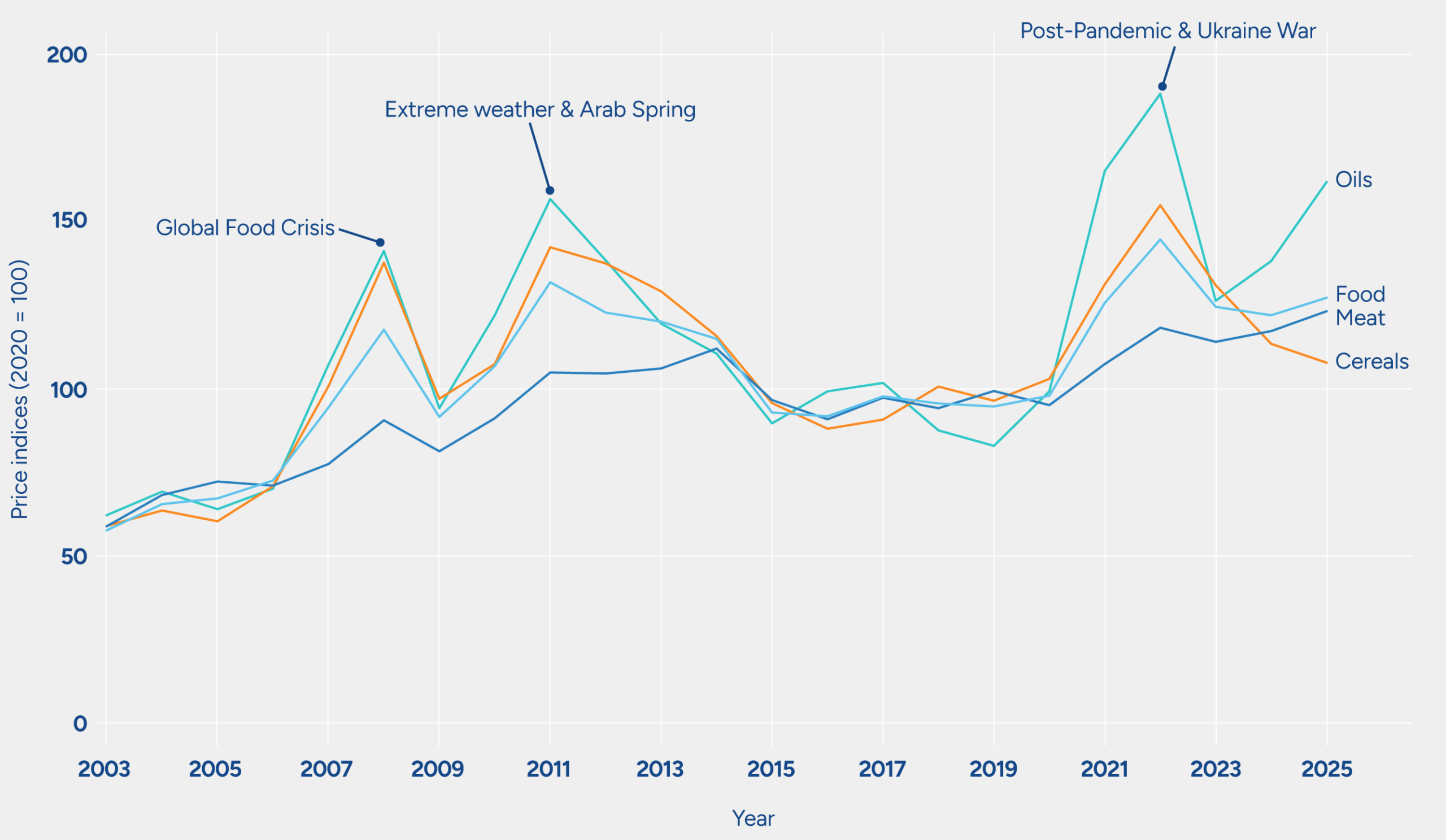
In The Perfect Storm, John Beddington argued that by 2030, the world would face a critical tipping point due to the simultaneous rise in demand for basic resources exacerbated by climate change. Looking at our economy and the state of the climate at the start of 2026, it’s not obvious that policymakers or business leaders have acted on many of his insights – although the topic of risk and resilience has returned with force in the past 12 months to sustainability conferences and press releases. The key question is, will this latest wave of interest in resilience translate to sustained and fundamental changes in business behaviour? Or will it simply see a re-badging of existing initiatives?
This post is the first in a new resilience series from 3Keel, where we’ll look at the concept of resilience and what it means for UK agriculture and for global supply chains. The series will seek to explore what the concept means in practice and demonstrate how adapting business models now is an even greater strategic imperative than it was fifteen years ago.
“During periods of stability, resilience is often sidelined. But when systemic shocks compound – as they did during the 2008 food price crisis – the lack of a buffer becomes evident. Back then, businesses treated food supply risks as temporary economic shocks. However, since COVID-19, the world has evolved into a state of ‘permacrisis’. Business focus is shifting from simple cost efficiency to navigating a complex web of geopolitical conflict, climate failure, and resource competition. Today, supply chain security is no longer a back office logistical concern; resilience is a strategic imperative.” Director Richard Sheane
The word resilience comes from the Latin verb resilire, which means “to recoil” or “to leap back”. For centuries, the word stayed in the realm of engineering and physics. However, in 1973, Canadian ecologist C.S. Holling published a seminal paper that changed everything. Holling used resilience to describe the ability of an ecosystem (like a forest or a coral reef) to absorb shocks and persist without completely collapsing. Since then the word’s use has grown exponentially as it has been applied to wider economic and social systems.
In the context of the food system, supply chain resilience was identified as one of five sub-themes in the UK’s 2024 Food Security Report. The report defined resilience as the ability of the food chain to respond to and withstand shocks and stresses through strengths such as diversity and adaptability. They considered shocks as immediate disruptions (e.g.,COVID-19) and stresses such as longer-term pressures (e.g., climate change).
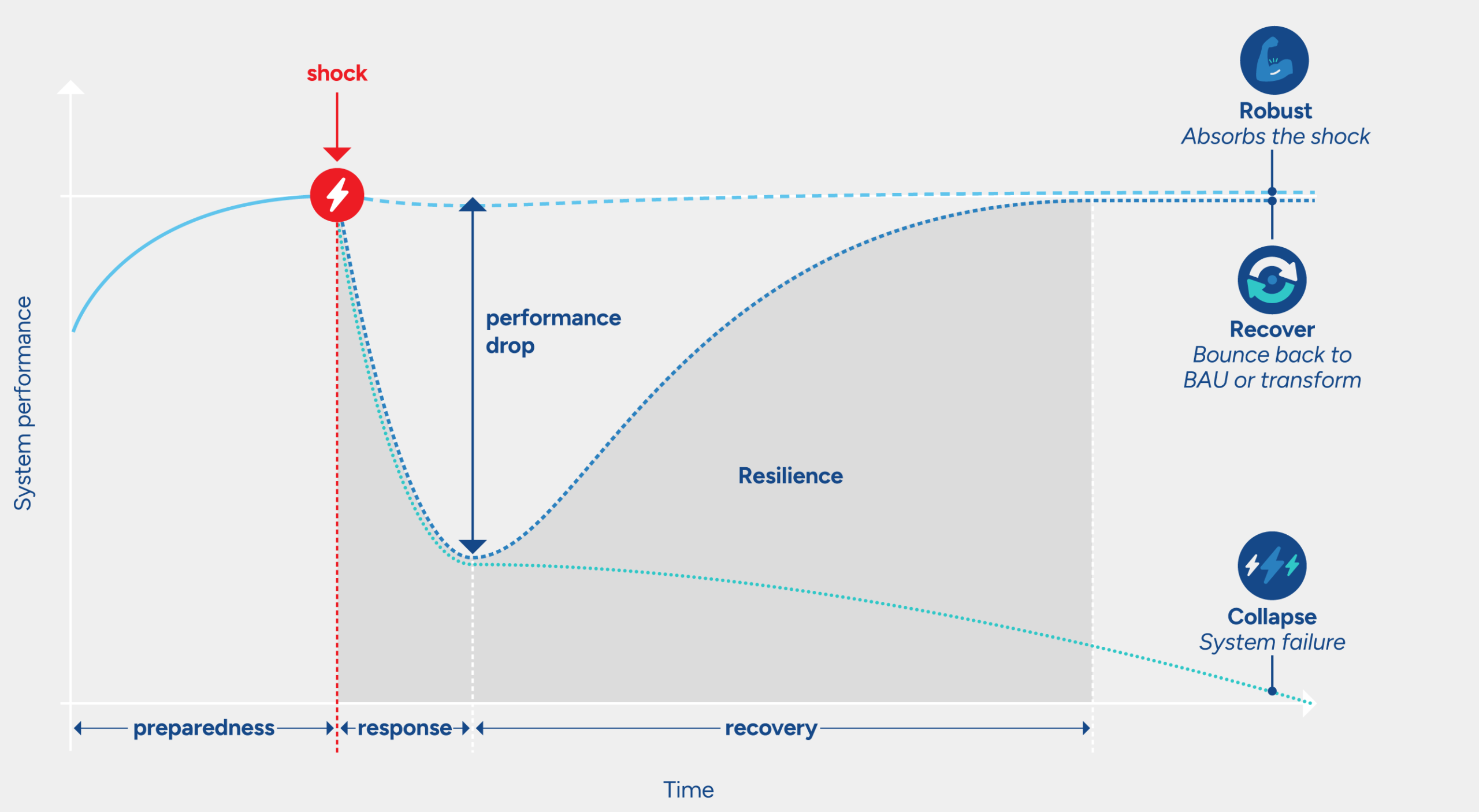
Resilience clearly offers a potential framework for corporate sustainability professionals to demonstrate how their goals are aligned with deeper commercial imperatives. Naturally, this can be easier said than done. After all, as a bit of a buzzword, resilience risks meaning both everything and nothing. The scope and definition of resilience also vary significantly, even within the same organisation. Farm-level resilience is often framed as the capacity of smallholders to withstand market volatility and weather extremes, whereas supply-chain resilience can be framed as managing logistical network bottlenecks and transport disruption through diversification and stockpiling.
Sustainability and resilience goals can be complementary. Whereas sustainability efforts have focused on mitigating environmental and social impacts. Resilience brings into closer focus the need to build capacity to adapt to shocks and reduce risk exposure. This thinking is already superficially reflected in concepts such as ‘double materiality’.
As a result, many existing sustainability initiatives already contribute to resilience. For example, regenerative agriculture can sequester carbon and improve soil health, helping farms withstand drought and stabilise yields. Win-win opportunities show that the path to resilience often starts with the sustainability work businesses are already doing – it’s simply a matter of looking at it through a new lens.
However, it’s critical to acknowledge that there will be significant tensions between some sustainability and business resilience strategies: it’s not always win-win. For example, removing cocoa from chocolate products (ingredient substitution) could potentially increase supply chain resilience to supply and price shocks, but it would have a major detrimental impact for small-holder farmer livelihoods. Sustainability professionals need to be sensitive to this risk as they rush to co-opt resilience in support of their work.
As climate change accelerates and geopolitical tensions persist, we believe resilience to shocks will become the defining capability of successful businesses. Organisations will need to operate within environmental and social boundaries, while also building the capacity to adapt, recover, and prosper in a rapidly changing world. Sustainability will remain an essential principle for responsible businesses, but resilience will provide an additional strategic framing that can unlock the case for more fundamental change.
Resilience can feel abstract until it is grounded in the lived realities of those within the food system. Coming up in the series, we will look at cocoa as an early warning signal for what may happen to other commodities.
To talk to us about resilience, contact Richard, Rob or Ruth using the form below or call the office on +44 1865 236500
 https://www.3keel.com/wp-content/uploads/2026/01/ruth_speak.webp
200
359
Ruth Jenkins
https://www.3keel.com/wp-content/uploads/2023/04/3keel_logo-1.png
Ruth Jenkins2026-01-30 09:50:442026-01-30 11:49:08Resilience is a strategic imperative for supply chain security
https://www.3keel.com/wp-content/uploads/2026/01/ruth_speak.webp
200
359
Ruth Jenkins
https://www.3keel.com/wp-content/uploads/2023/04/3keel_logo-1.png
Ruth Jenkins2026-01-30 09:50:442026-01-30 11:49:08Resilience is a strategic imperative for supply chain security https://www.3keel.com/wp-content/uploads/2025/10/je_sf.webp
200
359
Richard Scott
https://www.3keel.com/wp-content/uploads/2023/04/3keel_logo-1.png
Richard Scott2025-10-09 15:13:512025-10-09 15:13:51“To reduce damage to our oceans, we must involve those doing the fishing”
https://www.3keel.com/wp-content/uploads/2025/10/je_sf.webp
200
359
Richard Scott
https://www.3keel.com/wp-content/uploads/2023/04/3keel_logo-1.png
Richard Scott2025-10-09 15:13:512025-10-09 15:13:51“To reduce damage to our oceans, we must involve those doing the fishing” https://www.3keel.com/wp-content/uploads/2025/08/tp_jg_sf.webp
200
359
Richard Scott
https://www.3keel.com/wp-content/uploads/2023/04/3keel_logo-1.png
Richard Scott2025-09-12 07:08:352025-09-12 11:28:58“Tackling your impact on nature isn’t ‘nice to have’; it’s necessary”
https://www.3keel.com/wp-content/uploads/2025/08/tp_jg_sf.webp
200
359
Richard Scott
https://www.3keel.com/wp-content/uploads/2023/04/3keel_logo-1.png
Richard Scott2025-09-12 07:08:352025-09-12 11:28:58“Tackling your impact on nature isn’t ‘nice to have’; it’s necessary”